Friday, 1 December 2017

Story 24. War of the Dozers.

CAT D9L


Komtsu Dozer.


Shortly after EMECO took over Mt Gunson Mine from CSR in 1984 a well used Komatsu D4 size Dozer appeared on site.

Compared to the two much larger D9 Dozers we used on site in the mine, the tired little Komatsu was less than one quarter of their size and was simply too small to be of any use to the mining operation, we attempted to use it to push off the tip heads, but with dump trucks arriving every minute to deposit another 50 ton of overburden the tiny machine quickly became completely overwhelmed by the task plus it was in constant danger of being run over by even the smallest of equipment on site. The other problem was the tracks would often fall off usually in a most inappropriate location, or when reversing the blade side arms would sometimes become unattached and the blade would be dragged along by the hydraulic lift cylinders.

Originally the Dozer was proposed for use in the mill, management hoping its size would make it handy to assist with clean ups and getting in and among the various crushers, conveyors, or pushing in the feed at the main surge pile when the feed cone became to low. After trials in the mill it was found the task of pushing in feed could be performed much quicker and easier by one of the many 988B front end loaders we previously used.

The little dozer sat unused, in a quiet corner of the mill.

A problem arose when it was discovered who ever had this Dozer in their possession, was though the complexities of the P&L (Profit & Loss) accounting paper work being charged for its hire and use whether in use or not, (I suspect this Dozer was owned by one of the company directors and simply put out on site to appear as a hire and used to supplement his/her income ).

The Mill decided in an effort to eliminate the unwarranted cost, to secretly walk the machine 3km and hide somewhere it in an unfrequented part of the mine area.

The mine upon discovery of the diminutive tracks would easily locate its hiding spot and having no use for the Toy Dozer loaded it into the back of one of the dump trucks and driven back to the Mill where it was simply tipped onto the surge pile.
And so started a sort of to and fro war between the Mill and the Mine, where the unwanted Dozer made numerous trips up and down the haul road as each department fought to retain non possession .

Occasionally if the dump truck operator was engaged in carting ore to the mill and given the task of returning the Dozer, it was often accidentally tipped off into the actual primary crusher, when the driver simply forgot about the change of load. By the time the sound of screeching metal on metal as the tracks slid along the tray while exiting the truck was heard, it was far too late for the truck driver to stop the inevitable.

After returning the Dozer and depositing it onto the bottom of the surge pile late one evening, the Dozer war came to a quiet end, at least for three or four weeks.

While trying to reconcile his books at the end of the month the accountant noticed neither the Mine or Mill had included the tiny Dozer in their monthly figures, each department claimed not to have used or be in possession of the machine  and both claiming not to have seen or used it for over a month.

I was sent out to search the entire mine site and find the missing machine, management fearing it may have been stolen from site

After an entire day of following very old tracks and looking in places it was last reported the trail seem to have gone cold.

Searching through the service records I discovered the last sighting report was from the serviceman who had refueled it as part of his normal daily service of all equipment on site, and had listed it as being located in the Mill.

After spending a few hours on a 988 loader moving part of the huge surge pile I uncovered the dozer having spent the month completely buried under several thousand tons of crushed rock.

The Dozer then spent the next several weeks tagged out of service and parked out of the way near the workshop, conveniently forgotten, while waiting to be inspected for damage before being returned to service.

Story 23. Bangalore Torpedo's & Surge Bins

Warren Brown was the mine manager during CSR's ownership of Mt Gunson Mine, he encouraged employees to learn new kills and take on the occasional challenge.
This approach encouraged knowledge, experience and occasionally something a little unexpected,

After one of the overburden shots had been cleared and all the material had been dug out and after the area had been cleaned up it was noticed a large 500+ton rock hangup had occurred on the back wall of the overburden shot. This was a section of rock that had been included in the shot but for some reason the explosive had failed to move it so it hung as a large bulge of rock 15mtr long and four meters high and about a meter and a half thick, attached to the face, there were several original drill holes still visible passing completely through the back of the hang up, all empty and spaced 2.5 mtrs apart.
One of our training shot firers was given the task of calculating the required amount of explosive to enable this problem to be cut from the wall without damaging the wall face behind it.
The rock type known as Whyalla sandstone consisted of a mix of layers with numerous fault lines and variations in the actual hardness of the rock itself, this was a very difficult material to blast correctly and if not enough care was taken when loading the explosives, it would reward the shot firer by producing large 5, 10, or 15+ ton boulders with ease, making it difficult for the Front End Loaders to shift move or pick up and place into the back of the Dump trucks.

After careful calculations the suggested amount of explosive was loaded into a series of Bangalor torpedoes. A Bangalor torpedo is an explosive charge placed within one or several connected tubes, Originally used by combat engineers to clear obstacles that would otherwise require them to approach directly, possibly under fire. It is sometimes colloquially referred to as a "Bangalore mine", "banger" or simply "Bangalore" (wikipedia)

In this instance the explosive was placed in several lengths of 75mm PVC pipe. This allowed the explosive to be slid down into the existing holes which were open top and bottom.

The explosive in the form of a packaged sausage was tied with down line and after measuring the position with the aid of a tape measure lowered over the side of the face which then produced the measurement to lower the sausages down inside the PVC pipe to the required depth.
After tying the down lines together and clearing the pit, the time came to fire the charge, with the ultimate aim to sheer off in a clean cut and leave the face clear of the dangerous 500ton rocky hangup.

Warren Brown and a small group stood well clear on top of the pit watching as the charge was detonated.
A flash of det cord a milli second or two later the Bangalor Torpedo's all detonated sending rock and dust up and down the face behind the hangup, the sharp crack of the explosive reaching us a few seconds later.
As the dust cleared it became apparent the hangup had not shifted at all.
We waited, a minute and it became apparent nothing was going to happen.

Warren turned to the disappointed shot firer and began to explain that often even after doing all the calculations and planning it is always better to slightly overcharge the holes with explosive.
He then began a lecture on calculations for mass and quantities of explosive, when the overhang suddenly and quietly slid down the wall as one complete piece before noisily shattered into small pieces as it hit the floor ten meters below leaving behind a perfectly clean face looking as though it had been cut from the face with a knife while leaving half the drill hole still visible in the remaining face, making it a perfect result.

Warren shut up for a moment watching as the scene unfolded before him, Then, he went on,  there is beginners luck to consider, he said finally.


Mt Gunson Mill stock pile and round Surge bin(silo)
The Surge bin

At start of the feed conveyor in the Ball Mill stood a surge bin, this was a tall silo like structure that stood twenty meters tall and about six in diameter, the top was capped with a conical shape roof of corrugated iron to help keep the crushed ore dry.
It's purpose was to collect the final crushed rock, the fines and feed it onto the feed conveyor at a rate to maintain the constant flow of feed into the Ball mill where it would be ground down to a fine slurry to enable the copper and other minerals to be separated from the waste rock.


Occasionally the contents would hang up inside the bin, a series of compressed air jets fitted at various levels and locations about the circumference of the bin could be activated to blast the material loose.
Sometimes the air was unable to shift this material, when this happened the internal volume of the surge bin was reduced making it difficult to maintain a constant feed flow.
The solution was to lower a shot firer in through the top of the bin on a bosuns chair with an auger where he would drill a series of holes all around and at different levels through out the hang up material and cut a 20 or 30 mm slice from one or two plugs of the sausage explosive and insert it into the augured holes taking care not to over prime the entire bin with explosives. The object was to shake and loosen the hang up.
After one Christmas I was returning to the mine after having a week off to discover the entire roof of of the surge bin completely missing.

One of our ex army shot firers who had been staying on site over the Christmas break had been asked if he could give the bin a bit of a shake up. Miss-understanding the instruction of using only 20 to 30mm slices of the 70mm sausage explosive he took it to mean 20 to 30% of the explosive in each hole. The result of the using five plugs of explosive in an overcharge quickly removed the entire roof in a spectacular fashion sending it flying hundreds of meters into the air where it rained sheets of twisted corrugated iron down all over the mill area.

Oh well,

Wednesday, 29 November 2017

Story 22. Security Pass....Please!

The town of Woomera sits about 30km north of My Gunson, a bitumen section of road extended for about 35km south of Woomera, this was, I had been informed laid down in case an important visiting dignitary decide to go for a drive from Woomera.

The end of this paved section the road ended abruptly where it continued like an unmade bed full of tyre eating, potholes as the National Highway continued bone jarringly south for over 100km to where it joined up with the civilised section of the National Highway just a few km out from Port Augusta.

Up to the mid 80's Woomera was a closed town, any visitor wishing to visit the town was required to stop at a road block guard house and enter the building to fill in a visitors form, this included, name and address drivers license along with time of arrival, intention of the visit, names of anyone you intend to visit while in town and the time of your departure. (Note: Not this is not an estimated time of departure).
Woomera was home to 2000 American Airforce personnel who talked and listened to satellites they drove about in space from a secret base just a little way to the south on the shore of Island Lagoon.

Woomera also housed a number of personnel from the Australian Airforce and a contingent of boffins from the Australian Weapons Research Establishment who played about with stuff no one was suppose to know about. Occasionally the odd smoke trail shot skyward at one hell of  rate, letting off coloured explosives along the way or the occasional appearance of weird flying machines that spluttered about, sometimes a Mirage jet or two were spotted racing over the nearby flat salt pans letting loose some new type of ordinance that occasionally identified one of the concrete filled army tanks out on the lake as either a national threat or simply something that got in the way of it's ground skimming capability.

As a gliding instructor I knew a few of the glider pilots from the Woomera Gliding club having had a hand in their initial training at the Waikerie Gliding club. Also having been one of the training instructors I had also had a hand in the training of their flying instructors.
I sometimes visited the club simply as a means of getting away from the mine site for a while.
The club had two gliders an old but very well kept K-13 two seater and a KA-6 both kept in a far corner of an enormous locked hangar. Often when retrieving these aircraft other military aircraft would be discovered quietly parked in another corner of this enormous building which took a good fifteen to twenty minutes to unlock, walk the length of the hangar, retrieve the gliders, exit and re-secure and lock the doors while pretending to ignore the other aircraft with their load of weaponry and coloured painted bands in place didn't exist.
A few of the US airforce personnel joined the club and learn't to fly gliders while stationed in Woomera.

One morning I was assisting with the instructing when a short gentleman with a severe crew cut approached, his presence producing an instant response from the other Americans. As they stood to attention and acknowledge his presence.
Walking up to me he reminded me of an Ernest K Gann character out of the book, "Fate is the Hunter" and announced, I am Colonel Pepper and I would like to learn to fly.
The thought of teaching an American Airforce Colonel to fly  struck me as a little odd, then he went on to inform me not all Airforce personnel fly airplanes, I fly satellites.


A local plumber was doing a job in the nearby town of Pimba just 6km south of Woomera.
For almost a week he had been going back and forth several time during the day stopping at the guard house each time to show his pass, and sign the book, even though the guard knew him quite well as a local.
In a bit of a rush and having passed through the gate three or four time during the day, the plumber slowed and waved to the guard as he continued on his way.
Retrieving his weapon from inside the door the guard shot out a rear tyre of the plumbers vehicle effectively bringing it to a halt, he then walked to where the shocked plumber had come to a halt only a few meters past the gate.
Peering in at the plumber the guard said, "You forgot to show your security pass and sign the book". 


Story 21. The Fuel Truck

With a 24hr operation all machines were required to stop at sometime during the shift for refueling.
For the CAT 769 dump trucks it was easy, the serviceman would wait at the fuel pump reading a  copy of a Mills and Boom book and after the crew had their meal break he simply refuel each machine as they left the park area on their return into the pit.

The CAT988 loaders were refueled earlier in the pit during a ten minute crib break when the crews would grab a cup of coffee, cake or biscuits while the loader took on fuel and the pit fitter had a quick look over the machine.
The other machinery could be stopped at anytime with out disrupting production.

Also in the pit were two sometimes three large 14inch warman pumps powered by a 3208 Cat these pumps kept the water levels down and pumped the seeping water 140 feet up and out of the pit where it could be used in the mill or stored in any of the many dams.

With as many as three Loaders operating and fourteen dump trucks available the service truck visited each in turn.

One night shift while refuelling one of the pumps the service truck became semi-bogged in one of the sumps, truck tyres on the wet rock often made traction difficult.
Out service man discovered he could move a little both forward and back but was having great difficulty climbing over a small rise.
Frustrated he began going back a little further each time in an effort to increase the run up hoping the extra speed and momentum would help him make it up and over the small rise.
A large rock was preventing him from being able to go back any further, each time he reversed he did so until his progress was physically stopped by the rock as the back of the truck struck it each time bringing the truck to a sudden halt.
Frustrated at being stuck his reversing became more determined as the truck was brought to a sudden halt each time as it struck the large rock.

Seeing his plight the grader operator picked up a large heavy steel cable we used to pull the dump trucks out of  bogs, soft ground, and occasionally from over the edge of the dump when a dump truck had reversed a little too far and became stuck a little way down the slope.

Arriving he  found a highly agitated and certainly frustrated serviceman. They hooked the rope on and after a few minutes managed to drag the service truck free, much to the delight of the busy serviceman.

A quick inspection of the truck found by using the large rock as a back stop to bounce off in the search of added momentum the service man had shortened the trucks chassis by almost three feet!!


Close to the fuel pump stood a raised cleaning station, this was a small platform about three meters above the ground and positioned at the same height as the Dump truck's walkway. Behind was a raised water tank with clean water, this enabled the truck drivers to step out and clean the windows without having to climb up the truck carrying a heavy bucket of water to clean windows or wash out the often dusty interior of the cabin of the dump truck.

During one night shift a truck driver miss judged the platform and failed to stop the truck in time, knocking over the stand and with it went the 10,000 gal water tank.

This crew were from that moment on forever known as "F troop" from the popular TV show of the same name, which in the opening credits showed as similar water tank being knocked over.


and  

Tuesday, 28 November 2017

Story 20. Night Shift Can be Scary.

One of the most dangerous work practices especially in mining is shift work.
Night shift is easily the highest risk period of any workforce.

In CSR's time Mt Gunson worked three, eight hour shifts, night shift began at 11pm and ended at 7am.
Anyone who has ever worked a night shift will be aware the 3am to 5am period is the most dangerous time to work, it's also during this period the mind simply craves sleep. This is a problem experienced by every operator involved in the operation of heavy equipment.

The CSR mine management in the 1970-80's were stubbornly opposed to any equipment being fitted with a basic am/fm radio, "it would distract them" was one reason given, any suggestion of a two way radio being included in any of the equipment to enhance site communication was met with, "they will be playing with the darn thing all night and not concentrating on the job at hand".

There was little to nil understanding of basic fatigue management in the 1970-80 or the fatigue problems associated with a three eight hour shift roster in a camp environment.

A night shift worker ending his shift at 7am would shower and have breakfast, by the time they had completed a few domestic tasks or spent an hour or two socialising and relaxing before heading off to bed it would be around 10 - 10:30 am,  similar to a normal day experienced by permanent  day workers only it was time shifted 12 hours.

At at 3pm the afternoon shift crew would begin to prepare for their shift, clunking about in heavy work boots and generally raising the noise level in camp for an hour before heading off to work. Then shortly after 4pm the day shift would knock off and arrive back in camp, banging and crashing as they headed to the showers or the bar then sat about camp talking noisily and socialising.

Had a permanent day shift worker (or management) regularly experienced being woken every day at 3am and again at 4am the problem of sleep and fatigue would have been understood by management, but unfortunately this never happened.

Years later I was placed in charge of a large mine in Western Australia where administration management insisted on having a compulsory staff meeting every day at 2pm. when asked why not later at a more convenient time for night shift who after knocking off as 6 am having breakfast and got to bed by 9am were then required to get up at 1:30pm to attend the meeting which ended at 3pm. Night shift normally rose at 5pm to start their 12hr shift at 6pm as a result of this the night shift supervisors were getting only 4 hours sleep each day.
I was informed by the administrators the meeting time was based on the majority of attendees at work at that time, so it was easier for everyone.
The real reason behind the time chosen was the administration staff knocked off at 3pm and it suited them perfectly.
After senior management left me in charge for two weeks, I did a head count at the first meeting I chaired and found the night shift supervisors made up most of the attendees.
Using the understood rules I informed every one at the meeting for the next week all compulsory staff meetings would be conducted at 2am.

By day two every one had a working understanding of the problems they were imposing on night shift, by the end of the week compulsory staff meetings were agreed to be conducted at a more convenient time.

Mt Gunson mine worked an eleven day week, then shut down for three days.
 Almost all the workers left site and went home for the three days.

The last shift was night shift which ended at 6am, knowing everyone would be in a rush to leave site I would spend an hour filling in everyone's time sheets leaving only the load count, and a signature needed to complete the paperwork as they made their way through the office.

I would knock off a half hour behind the crew after dropping off the maintenance forms and paperwork at the main administration office.

While driving south after one night shift, I was about 50km south of the mine when I noticed one of the operators vehicle stopped on the side of the road and parked in an odd sort of way with the front wheels against a small windrow. I stopped and walked over to see if the driver was in trouble and needed help.
As I approached I noticed he was sound asleep at the wheel, the engine still running and the automatic transmission still in gear. Obviously he had fallen asleep and the car had simply continued on its own for a while, his foot had dropped off the accelerator, allowing the vehicle to slow down then eventually run off the long lonely stretch of road where it was slowed further by the soft dirt and eventually come up against the windrow and been brought to a complete stop.

I reached through the open window and moved the transmission to the park position.
Then I lay on the engine bonnet and looking in through the front window knocked loudly on the windscreen.
The driver stirred, then suddenly realising he was driving grabbed the steering wheel.
At the same time I screamed at him, he screamed back at the sudden appearance of the terrified face looking at him through the cars window while trying to swerve left and right as he attempted to bring the already stationary vehicle to a complete halt.
I climbed off the front and peered in.
Are you awake Harry? I asked.
Where in the blood hell did you come from? he said appearing unsure of what just happened and my sudden, unexpected appearance while he thought he was still driving.
I left site a half an hour after everyone left, I explained.
Oh shit I must have fallen asleep. he said, I'm wide awake now.
He looked it. Good, now Ill follow you into Pt Augusta and we will stop for a coffee, I said.
And a change of underwear, Harry added.

Sunday, 26 November 2017

Story 19. That's My Bloody Ore Body.


The years 1980 to 1984 South Australia was in the grips of a drought, the normal 200mm (4inch) of rain fall a year failed to arrive four years in a row in an area with an evaporation rate of 3.5metres (11 1/2 feet) a year.

By Christmas 1984 all the grass in the area had long gone exposing the red sand, sheep had trimmed the underside of all the trees the lowest branches had been raised almost two meters, sheep stations had sold off their stock, rabbits were seen climbing trees to just find something to eat.

In certain areas it was possible to sit on the ground and see for miles under the raised skirts of the trees where the undergrowth had vanished.
Thousands of kangaroos moved into Woomera every night to graze on the town lawns and ovals or anything that resembled an edible green.

For months a drilling company we had often used had been conducting exploration drilling through the Woomera restricted zone for another company and were nearing the last two holes of the exploration line. With only two weeks before Christmas they had been hoping to be able to finish the contract before Christmas rather than have to return to complete just two or three after the holidays.

With nothing of interest to show for months of work the client had indicated they were loosing interest and would be agreeable if the driller wanted to abandon the last two holes and return home for Christmas, ending the exploration program slightly early.

With two holes to go rain began to fall in the area for the first time in four years.
By morning all the tracks in the area were impassable to all but 4WD vehicles, no way the heavy drilling rig would be able to go anywhere for a few days.
Facing the fact they were rained in, it was decided to drill the remaining holes while waiting for the tracks to dry out.

Parked near a small dam they completed the drilling and with only a day before Christmas they packed up and began the slow journey south.

With the truck and vehicles covered in the sticky red mud they decided to pull into Mt Gunson for a few hours to wash for the first time in months and blast the sticky mud off the vehicles for the long trip south.
Being ever curious as to what the drillers were up to Allen Turnbull stopped by.

The driller complained the last two holes took much longer to drill because of the nature of the rock he showed Allen the retrieved sample of rock.

Allens eyes lit up as he inspected the sample.
Hard rock be buggered he said, "That's my missing bloody ore body he said.
Where did this come from? he asked.

The driller thought for a moment then informed Allen about 100km north of Woomera, near a small dam, retrieving the exploration map where after a few moments identified the location, pointed out the small insignificant dam, the map identified as, Olympic Dam.


Story 18. Drilling on Island Lagoon.


Despite several discussions between CSR's management and Mt Gunson's Allen Turnbull the self taught site geologist about additional exploration of the ore body we were mining Allen was having considerable difficulty convincing CSR to do any exploration drilling.

In the late 1970's Allen knew the sulphide ore body we were mining was only a remote off shoot to a much larger ore body that lay somewhere close by along a fault line that ran roughly north south from Strathalbyn just south east of Adelaide to Burra continuing on and along the western side of Pernatty Lagoon and Mt Gunson where it continued northward.
Other parallel faults containing copper also ran though the Kadina, Moonta area. Alan could only raise a luke warm response from the bloody Sugar Miner as Allen called CSR's senior geologist who only agreed to do some basic infill drilling to explore the immediate area around the immediate Mt Gunson ore body.

The Mt Gunson ore body contained copper, zinc, lead, silver and cobalt which was a problem at the extraction process for both copper and cobalt were very similar, this was a bit of a problem of which we were penalized as it was considered a contaminate by the customer, what it didn't contain was gold, this along with other clues indicated it was just a minor part of a much larger, or as Allen called it, "the real ore body".

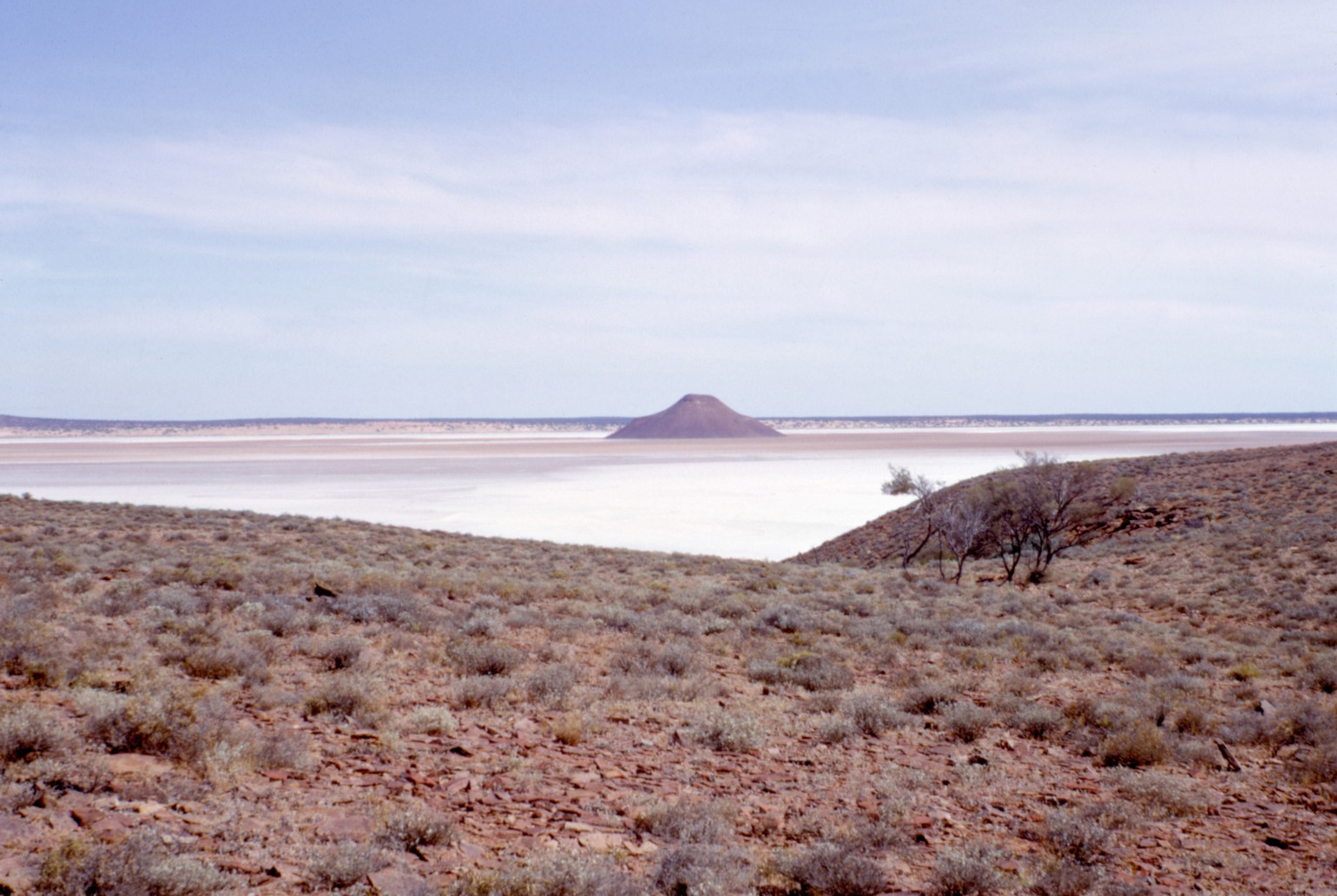
In the early 1980's CSR decided to allow some shallow exploratory drilling to the north west of the mine on the salt lake of Island Lagoon, along a 5km line between an iconic cone that gave Island Lagoon its name and the eastern shore.


ISLAND LAGOON Salt Lake sth of Woomera South Australia.
 

Rather than pleasing Allen the idea he knew was a waste of time and was absolutely bloody furious at CSR's bloody stupidity and argued with the senior bloody senior bloody Sugar Miner there was bloody nothing under bloody Island bloody Lagoon except bloody hematite which had been bloody test drilled back in the bloody 1950' and there are already bloody great mines in bloody Western Australia digging up bloody great lumps of the bloody stuff.

There were two problems drilling the lagoon, one was its inability to support heavy equipment, The so called dry salt lake was like most "dry" salt lakes in Australia are only dry for the first 10mm or so of the surface. Once the thin surface layer of the salt is broken, a thick, clingy, black to brown mud waited below to trap any one stupid enough to try to challenge it. To get a heavy air track drill 5km off shore would require careful planning along with a system to allow day to day servicing and refueling of the drilling equipment.

The second problem was the Island Lagoon area also contained an very sensitive and highly secure American Secret Satellite communication base on the North Eastern corner of the Lagoon.
Never the less to prove stupidity has no limit CSR persisted and after negotiations with the American base, Government agencies, Woomera security and a drilling company willing to risk loosing a drill or ancillary equipment beneath the pristine salt surface with little regard to the fact they would also be ruining a popular tourist photographic spot.

After months of preparations, a drill was delivered to the rocky eastern shore of the lagoon where it was broken down into three major components.

A Bell Jet Ranger  helicopter arrived and the first section of the drill was hooked on.
As we watched it take up the slack and prepared to lift it into the air the noise and the surroundings began to vibrate with a lot more energy than I had expected from the chopper even when lifting the heavy load.

I looked around to discover a much larger military Huey Chopper standing off close by watching the operation.
As the Bell lifted the load and moved off toward the Needle the Huey moved with it maintaining a position between the Bell and the Secret base, preventing any thought the Bell may have in making a dash toward the base.
As the Bell returned for the next section and for each additional flight the two choppers flew to and fro, in parallel, together.

Six months later the drill had slowly walked back to shore as it completed its drilling program along the way and proved the 1950's drilling and discovery Hematite was in abundance was bloody correct.

Bloody Sugar miners!


Geoff.

Windoze ME Hi team I hope to eventually introduce new pages to the Blog.     On Aviation. Flying, Gliding and the other forms. 1971...